
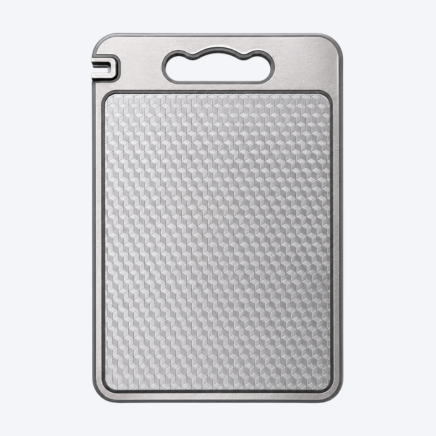
Best Titanium Cutting Boards: Top 5 Tested

Kitchen · Buying guide

The 5 best titanium cutting boards

Metal boards are the fastest-growing corner of the kitchen aisle, sold on hygiene and on getting plastic off the countertop. We compared five of them on what actually matters day to day — surface hygiene, durability, cleaning and how they treat your knives.

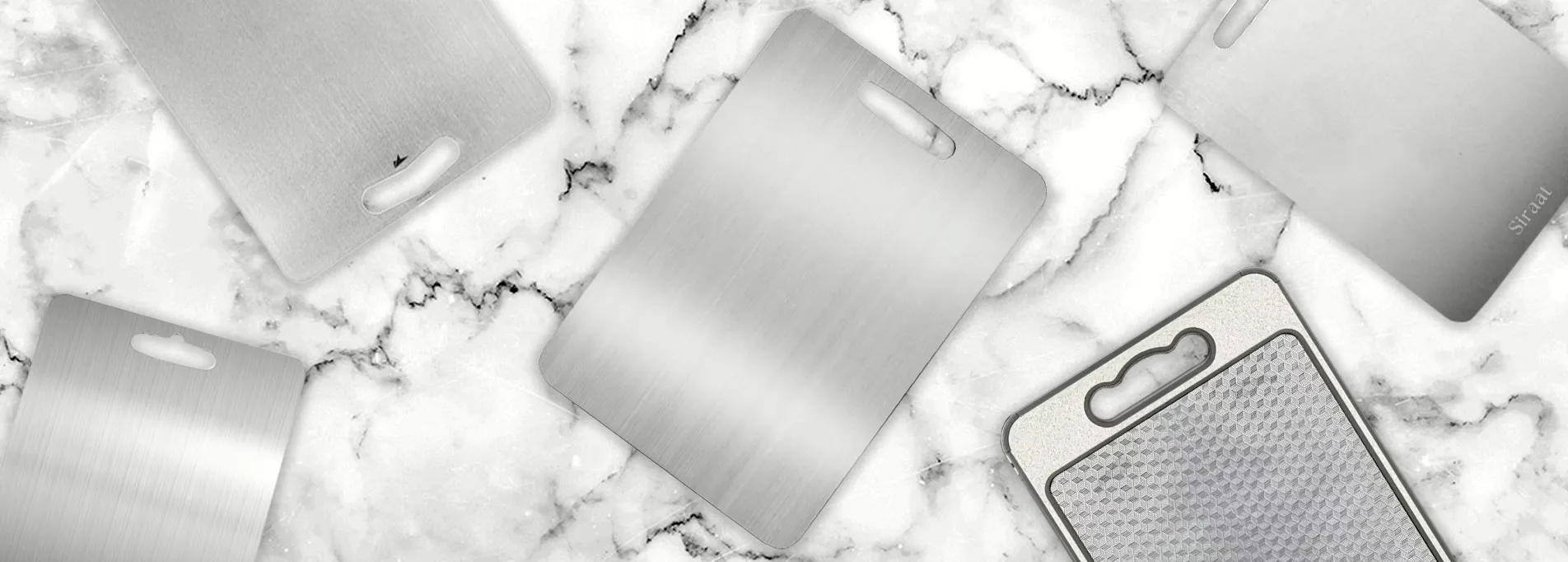
The five titanium cutting boards compared in this guide
Five boards compared — ranked below

Gavin reviews everyday household products — the kind that solve an ordinary problem without a specialist or a big outlay. His focus is the gap between what a product claims on the box and what it does in a normal kitchen.

See the #1 pick →

Cutting boards are the one kitchen item people replace without ever deciding to. Plastic boards get scored by knives, the grooves hold on to whatever was cut last, and they go in the trash every year or two. Wooden boards last longer but soak up moisture, warp, stain, and cannot go in a dishwasher.

Metal boards are the response to both problems, and titanium is the material the category has settled on. Before the rankings, though, one claim on nearly every listing needs unpacking — because it is not quite true, and the truth behind it is actually the better reason to buy.

Quick answers first

Five questions worth settling before you buy. Full detail below.

Is titanium really "naturally antibacterial"?

Not in the way the phrase suggests. Copper and silver actively kill microbes on contact. Titanium does not — it is bioinert, which is precisely why it is used for surgical implants: it does not react with anything.

The real advantage is simpler and more useful: the surface is non-porous and does not score deeply. Bacteria on a cutting board is a problem because knife grooves in plastic and open grain in wood give it somewhere to sit where washing cannot reach. A hard, non-porous surface gives it nowhere to hide, so an ordinary wash actually removes it. That is a hygiene benefit worth paying for — it just is not the same thing as an antibacterial coating.

Worth knowing: in the US, marketing a product as killing or inhibiting bacteria generally puts it under EPA pesticide registration rules. A listing that leans hard on an antibacterial claim without that registration behind it is making a marketing statement, not a certified one.

Will a metal board ruin my knives?

Be straight about this one: metal is harder than wood or plastic, and a harder surface takes more edge off a blade over time. Board makers work around it with textured or slightly compliant surfaces, and some do it better than others, but no metal board is as kind to an edge as end-grain wood. If keeping a Japanese knife hair-splitting sharp is your priority, buy wood. If you want a board that never harbors bacteria, never warps and outlives every plastic board you would otherwise buy, the trade is worth making — and a honing steel closes the gap. One board in this group builds the sharpener into the board itself, which is the most practical answer we found to the one real drawback of the category.

What about microplastics from plastic boards?

The concern is real and has been documented: chopping on a plastic board sheds fine particles into food, and the more scored the board, the more it sheds. Whether that matters to your health is not settled science, but if getting plastic out of food preparation is the reason you are here, a metal board removes the source entirely. So does wood. Note that some boards pair a metal face with a composite face — if eliminating plastic is the whole point for you, it is the metal side that does it.

Is a double-sided board actually useful?

More than most features on a listing. Cross-contamination between raw meat and food eaten raw is the genuine food-safety risk in a home kitchen, and a dedicated side for each is the simplest way to manage it. It is the one design feature here that maps directly onto how food-safety guidance says to work. The catch with most two-sided boards is that both faces look identical, so people lose track of which side they used for chicken — which defeats the purpose.

Can it really take a hot pan and go in the dishwasher?

Yes, and that is a fair reason to switch. Metal does not warp from heat or water, so a board can double as a trivet and go straight into the dishwasher — neither of which is true of wood, and the second of which destroys most wooden boards. Check each manufacturer's stated temperature limit rather than assuming.

How we compared them

We assessed five of the most widely sold titanium boards on the same points: how the surface holds up to hygiene in practice, resistance to scratching and warping, heat and dishwasher tolerance, how the surface treats a knife edge, everyday handling — weight, stability, whether it is double-sided — and price against what is included.

Two things separated the field. First, double-sided construction: the boards that have it are meaningfully more useful, and one of the ones that does not is also the most expensive here. Second, weight and rigidity — several boards are either heavy enough to be a chore or thin enough to flex on the counter, and both make daily prep worse.

Scores are our editorial assessment based on manufacturer specifications, published seller information and buyer feedback. They are not laboratory measurements, and we make no clinical or health claims for any product on this page.

What matters — and what to walk away from

Look for

  • A double-sided design for raw and ready-to-eat food
  • Two faces you can tell apart without thinking
  • Rigidity — a board that does not flex under pressure
  • A stated heat limit and dishwasher rating
  • Enough weight to stay put, not so much it is a chore
  • A named seller with a real returns process

Walk away from

  • Antibacterial claims with no certification behind them
  • Thin boards that bend or bow in use
  • Premium pricing with no functional advantage
  • Boards heavy enough that you stop reaching for them
  • Invented stock counters and countdown timers
  • Listings with no material specification at all

At a glance

The full write-up for each board follows the table.

#BoardDouble-sidedBest forWatch out forScore
1KensaiChefYes — two materialsKeeping meat and produce apartOnline only9.4
2Takeshi — Samurai ShackYesBudget buyersLower heat tolerance8.6
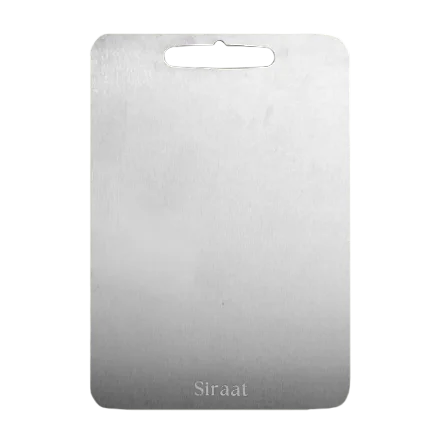
3Original Siraat — SiraatNoSize options, craft finishFlexes; high price8.2
4Titanium Cutting Board — KeithNoLow outlayHeavy; scratches early7.1
5Original Taima — TaimaNoSingle-purpose useMost expensive; heavy6.3

The top 5, ranked

01 · Best overall Editor's pick
KensaiChef titanium cutting board

KensaiChef

Double-sided titanium cutting board

Titanium + wheat straw faces · dishwasher-safe · built-in sharpener

Surface hygiene
95
Durability & heat
94
Ease of cleaning
96
Everyday handling
95
Knife friendliness
80
9.4/ 10Overall

KensaiChef took the top spot on a detail the rest of the category gets wrong. It is double-sided — but the two faces are made of different materials: pure titanium on one side for raw meat and fish, a wheat-straw surface on the other for vegetables and fruit.

That sounds like a styling choice. It is the opposite. The reason two-sided boards fail in practice is that both faces look identical, so after a week nobody remembers which side had the chicken on it, and the separation that justified buying the board quietly stops happening. Two visibly and texturally different surfaces remove the guesswork: you cannot mix them up, so the habit actually holds.

It also answers the one legitimate complaint about metal boards instead of ignoring it. Every board here is harder on a knife edge than end-grain wood — KensaiChef builds a knife sharpener into the board, so the touch-up happens where the dulling happens. There is a garlic and spice grinder built in as well, a textured section on the titanium face intended to speed up defrosting, rounded edges, a non-slip base and a hanging hole. Both faces go in the dishwasher.

At roughly 12.2 × 8.3 in and 1.2 lb it is a daily-prep board, not a butcher block. That is the honest limit: plenty of room for dinner, not enough for breaking down a turkey. And if removing plastic from food prep entirely is your goal, the titanium face is the side that does it — the wheat-straw face is a fiber composite. Use the titanium side for meat as intended and that point is moot.

Pros

  • Two different materials — the sides cannot be confused
  • Titanium face for raw meat, wheat straw for produce
  • Knife sharpener built into the board
  • Garlic and spice grinder integrated
  • Non-porous titanium face, nothing for bacteria to sit in
  • Textured section intended to speed defrosting
  • Dishwasher-safe on both sides
  • Resists odors, stains and warping
  • Non-slip base, rounded edges, hanging hole
  • Light enough to take camping or to a cookout

Cons

  • Sold direct online, not in stores
Check price & availability →

Opens the official store · Check current price, shipping and return terms there
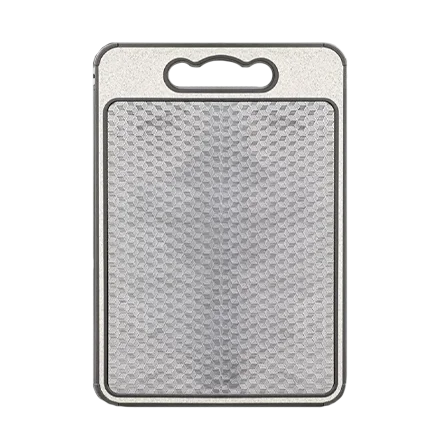
02 · Best budget option
Takeshi titanium cutting board by Samurai Shack

Takeshi

by Samurai Shack · titanium board

Double-sided · third-party certified · budget entry

Surface hygiene
90
Durability & heat
68
Ease of cleaning
88
Everyday handling
84
Knife friendliness
72
8.6/ 10Overall

The best value here and the only other double-sided board in the group. It also carries third-party certification, which in a category full of unverified hygiene claims counts for something — it is a real document rather than a marketing line.

Where it gives ground is construction. Heat tolerance is lower than the top pick, so it is not a board to rest a pan on, and the two-piece build has a seam that buyers report as a weak point under rough handling. If budget is the deciding factor and you will treat it carefully, it is a sensible buy.

Pros

  • Double-sided design
  • Third-party certified
  • Non-porous, easy to clean
  • Lowest price of the five

Cons

  • Limited heat resistance
  • Two-piece build is a weak point
  • Less durable under heavy use
03 · Best range of sizes
Original Siraat titanium cutting board

Original Siraat

by Siraat · titanium board

Single-sided · multiple sizes · craft finish

Surface hygiene
88
Durability & heat
70
Ease of cleaning
86
Everyday handling
74
Knife friendliness
64
8.2/ 10Overall

The best-presented board of the group, with a Japanese handcrafted finish and the widest choice of sizes — genuinely useful if you want a small board for herbs and a large one for breaking down a chicken.

Two problems keep it out of the top two. It flexes noticeably under pressure, which is unpleasant when you are pushing through something dense and undermines confidence in the build. And it is single-sided at a price above both boards ranked higher, so you are paying more for less function. Beautiful object, weaker tool.

Pros

  • Japanese handcrafted finish
  • Widest choice of sizes
  • Non-porous, mold-free build

Cons

  • Flexes under pressure
  • Single-sided at a premium price
  • No surface treatment for knife edges
04 · Cheap, and it shows
Keith titanium cutting board

Titanium Cutting Board

by Keith · titanium board

Single-sided · double-layer build · heavy

Surface hygiene
84
Durability & heat
58
Ease of cleaning
80
Everyday handling
52
Knife friendliness
60
7.1/ 10Overall

The cheapest way into the category after the Takeshi, with a hygienic non-porous surface and a double-layer construction that sounds more substantial than it is in use.

It picks up light scratching within the first few uses, which for a board sold on scratch resistance is the wrong first impression — and every scratch is somewhere for residue to sit, undercutting the reason to buy metal at all. It is also the heaviest board here relative to its size, enough that it becomes the one you leave in the cupboard.

Pros

  • Low price
  • Non-porous, hygienic surface
  • Double-layer construction

Cons

  • Light scratching after only a few uses
  • Very heavy for its size
  • No surface treatment for knife edges
  • Durability concerns over time
05 · Hard to recommend
Original Taima titanium cutting board

Original Taima

by Taima · titanium board

Single-sided · multiple sizes · premium price

Surface hygiene
76
Durability & heat
72
Ease of cleaning
78
Everyday handling
50
Knife friendliness
46
6.3/ 10Overall

Last place, and the reasoning is straightforward: it is the most expensive board here, the only one with no second face, one of the heaviest, and the one buyers most often report causing knife damage.

The build quality is real and it is odorless and easy to keep clean, so it is not a bad object. But it is priced as a premium product while offering less function than boards costing considerably less, and the hygiene claims on the listing are thinner than the price implies. Only worth considering on a deep discount and only if you want one board for one job.

Pros

  • Solid build quality
  • Odorless, easy to clean
  • Multiple sizes available

Cons

  • Most expensive of the five
  • No second side for raw food
  • Heavier than the class
  • Buyers report knife damage
  • Hygiene claims thinner than the price suggests

Getting the hygiene part right

A non-porous board removes the hiding places, but it is not a substitute for handling food properly. Whichever board you buy, these are the practices that actually prevent cross-contamination in a home kitchen.

The basics, every time:

  • Keep raw meat and ready-to-eat food on separate surfaces — a dedicated side, or a second board.
  • Wash with hot soapy water after raw meat, not just a rinse.
  • Dry the board before storing; moisture trapped underneath is its own problem.
  • Wash your hands between handling raw and cooked food, every time.
  • Retire any board — metal, wood or plastic — once the surface is deeply scored.

No cutting board of any material makes food safe on its own. The board is one part of good kitchen practice.

What buyers report

A published customer review of our top pick, plus recurring themes in buyer feedback. These are customer opinions, not measured results.

“No more fear of germs”

“Since switching to KensaiChef, I feel so much better about preparing food. I can keep raw meat and fresh veggies on separate surfaces, and cleanup is so quick and easy!”

Customer review published on the official KensaiChef site

Most-repeated positive: cleaning. Buyers coming from wood or scored plastic single out that a rinse actually leaves the surface clean, with no odor carried over.

Recurring theme · cleaning

Most common adjustment: the sound and feel of chopping on metal. Buyers describe it as taking a few sessions to get used to after years on wood.

Recurring theme · adjustment

Frequently asked

Can it go in the dishwasher?

Yes. Metal does not absorb water or warp, so dishwasher cycles are not a problem — unlike wooden boards, which a dishwasher will destroy. Our top pick is rated dishwasher-safe on both faces.

Which side do I use for what?

On a two-material board like our top pick, the titanium face is for raw meat and fish and the other face is for vegetables, fruit and anything eaten raw. That split is the whole point of the design, and it is the habit worth getting right whichever board you buy.

Will it slide around on the counter?

A rigid board with some weight to it stays put better than a light plastic one, and a non-slip base helps more than weight does. If any board moves on your counter, a damp cloth underneath fixes it — that applies to every material.

Does it stain from turmeric, beets or tomato?

No. Staining happens when pigment soaks into a porous surface, which is why wood and plastic discolor. A non-porous metal surface has nothing to absorb into.

Is it noisy to chop on?

Yes, more than wood. Metal transmits the impact of the blade rather than absorbing it. Most people stop noticing after a week or so, but it is a real difference and worth knowing before you buy.

Should I still keep a wooden board?

Many people do, and it is a reasonable setup: metal for raw meat and anything that stains or smells, wood for bread and general prep where edge retention matters more than hygiene. They solve different problems.

What about returns and shipping?

Return windows, shipping times and warranty terms are set by the seller and can change. The official store for our top pick advertises a 30-day money-back guarantee at the time of writing — confirm the current terms on the product page before ordering, since we do not control them. See our Returns Policy and Track My Order pages for how we handle inquiries.

Our top pick

Of the five boards we compared, KensaiChef was the most complete — two different surfaces you cannot confuse, a sharpener built into the board, dishwasher-safe and heat-tolerant.

Check price & availability →

Price and stock shown on the official store